
From the Thrones of the East and the Midrealm, greetings to all who gather for Pennsic 53. We welcome you to the War Point Scenarios, an array of challenges and endeavors that reflect the full breadth of talent, passion, and dedication within our Society.
Pennsic is more than a field of battle. It is a living tapestry woven from many strengths: the precision of Rapier and Armored Combat; the keen focus of Archery, Thrown Weapons, and Missile activities; the creativity and scholarship of the Arts & Sciences; and the steadfast devotion of those who serve. Each discipline enriches our War and gives it depth, color, and meaning.
The scenarios and competitions before you have been crafted to inspire — inviting you to test your skills, explore new ideas, and share in moments of triumph, challenge, and discovery. Whether your path leads you to the lists, the ranges, the studios, or the places where quiet service keeps our great War thriving, your contributions shape the experience we all cherish.
Yet above all, we gather under a shared commitment to safety, honor, and respect. No accolade or achievement outweighs the well‑being of our community. We all share the responsibility to ensure that every endeavor is pursued with awareness and care.
So step forward with confidence. Create boldly. Compete with joy. Serve with pride. Celebrate the fellowship of those around you, whatever tools they wield — be they blades, bows, brushes, books, or the countless instruments of service. And when each day’s efforts are done, may all return in good health and high spirits, ready to share stories of inspiration, ingenuity, and the bonds strengthened through shared purpose.
For the greatest victory at Pennsic is not measured in points, but in a War where all may participate fully, challenge themselves boldly, and return home enriched by the experience.
In Service to the Dream,

General Notes and Conventions
Start Times
It is the intention of the Crowns of the East and the Midrealm and Marshalate of the East, Midrealm, and Æthelmearc, that all battles will start at the published time.
Fairness & Fun
The Crowns of the East and the Midrealm are committed to ensuring that Pennsic War 53 is fair and fun.
We agree to review the effort between each armored and rapier scenario and balance accordingly.
Pennsic Marshal Staff
Aethelmearc (Marshal 1) Earl Marshal: Sir Ardan Scot (marshal@marshal.aethelmearc.org)
East (Marshal 2) Earl Marshal: Barun Pádraig Ó Brádaigh, called Samson (earl-marshal@eastkingdom.org)
Mid (Marshal 3) Earl Marshal: Sir Marcus Pinarius Draconarius (marshal@midrealm.org)
Pennsic Combat Conventions
This list is not complete and exists to call to attention some rules that may differ from kingdom-to-kingdom.
For complete Pennsic conventions and rules, refer to the Marshal Conventions published by the Pennsic marshalate.
Armored Combat Conventions at Pennsic
● Side and top of the helm are proof against thrusts (including spear and CA)
● Death from behind and dead on the ground are NOT in use
● Butt spikes are not used on single-handed swords
● Fellwalker ammo is not to be fired from heavy crossbow
● Siege normal targeting (all shots to all legal target areas count)
● Missiles and Thrown Weapons:
- Due to the safety limits placed on these weapons, including the low mass of the ammunition, missiles will typically strike with less force than a handheld weapon.
- Missiles and thrown weapons do not need to strike with the same force as a handheld weapon to be an effective blow
- You are not expected to acknowledge a blow that you are not aware has occurred
- This does not transfer the responsibility of judging the effects of blows to the archer, as it is left to your honor as the combatant being struck to judge the effects
- The effects of a blow from a missile depends on the type of munition (e.g. siege or combat archery) and where it strikes you.
- Missiles (e.g. siege munitions, arrows and bolts, and thrown weapons) are considered spent when they strike their first target, the ground or a battlefield structure.
Rapier Combat Conventions at Pennsic
- Knee walking is allowed unless specifically stated otherwise
- Death from Behind is allowed in all war point scenarios. Only swords may be used for Death from Behind
- Push and tip cuts (in addition to Draw Cuts) are valid
- For a cut to be counted, there must be at least 6 inches (15 cm) of movement with the blade or travel of the tip against the target. Cuts that move across the entire width of a limb or the throat will count even if they are not 6 inches long
- Tip Cut – The point of the blade is placed upon the opponent and moves across the opponent by dragging along the line of the edge of the sword
- Push Cut – The edge of the blade is placed upon the opponent and slides in line of the sword by pushing (i.e. contact starts closer to the tip and ends closer to the hilt) A tip cut is 6” of travel on the body or the width of a limb
- Draw Cut – The edge of the blade is placed upon the opponent and slides in the line of the sword by drawing (i.e. contact starts closer to the hilt and ends closer to the tip)
- Running engagement is NOT allowed
- Charging, running, hopping, or other attack where the fencer cannot immediately cease movement when a hold is called is prohibited
- Rapier Spears:
- The only valid blow with a spear is a thrust. (Draw cuts, tip cuts, and push cuts are not valid.
- Death from behind is not allowed with a spear)
- Spears will be re-inspected prior to every battle
- Spears are only allowed in battles where stated
- There is no combat archery allowed in fencing at Pennsic
Command Staff
- Warlords:
- East and Allies: Sir Tiberius Iulius Rufus Primus
- Midrealm and Allies: Sir Crispin de la Rochefoucauld
- Armored Combat:
- East and Allies:
- Armored Combat General: Master Tiernan Mac Ailpin
- Deputy/XO: Kit de Coldwood
- Deputy/XO: Hassan Ibn Abd Al-Malik
- Missile Commander: Master Vopiscus Rufius Donatus
- Duel Captain: Duke Brennan Mac Fearghus
- Midrealm and Allies:
- Armored Combat General: Master Vitus Aurelius (Vito)
- Chief of Staff : Master Max von Augsburg
- Siege / Combat Archery General: Sgt (HE) Tamsin
- Siege / Combat Archery Executive Officer: Sgt Algar
- Heroic Champions Commander: Duke Wigthegn the Younger
- East and Allies:
- Rapier Combat:
- East and Allies:
- Rapier General: Caoilfhionn inghean Fhaoláin, Dux
- XO: Baroness Muirenn Ingen Ciric
- XO: Master Eldrich Gaiman
- Duel Captain: Master Robert Tytes
- Melee Champions Captain: Don Thora Kottr
- Midrealm and Allies:
- Rapier General: Captain Mael Duin
- XO: Maks Pellyson
- Heroic Champions Coach: Maestro Raphael di Merisi
- Melee Champions Captain: Warder Aminita Villarosa
- East and Allies:
- Archery & Thrown Weapons:
- East and Allies:
- Archery General: Master Ryan McWhyte
- Thrown Weapons General: Safiya al-Naghira
- Midrealm and Allies:
- Archery General: Forester Cadfan of the Autumn Wood
- Thrown Weapons General: Prudence of Colleah
- East and Allies:
- Arts & Sciences:
- East and Allies:
- A&S General: Abu-Duruz Ibrahim ibn Musa bin Sulayman al-Rashid
- Second in Command: Maestrina Chiaretta di Fiore, OL
- MOAS: Mistress Raziya bint Rusa, OL
- Midrealm and Allies:
- A&S General: Baroness Roana Aldinoch, OP OL
- Executive Officer: Baroness Sadb ingen Neill, OL
- KMOAS: Baronowa Alzbeta Mihalik, OP OL
- East and Allies:
Summary Schedule
Saturday
2pm – Meeting of the Crowns
6pm – Opening Ceremonies
Sunday
9am – Heroic Head-to-Head Shoot
10am – Armored Champions Melees
12pm – Rapier Champions Melees
1:30pm – Heroic Champions
Monday
9:30am – A&S Champions (set up 7:30am)
10am – Armored Bridge Battle
1pm – Rapier Stronghold Battle
Tuesday
9am – Archery Champions
10:30am – Armored Woods Battle (or alternate battle)
1:30pm – Rapier Woods Battle (or alternate battle)
Thursday
8:30am – Thrown Weapons Champions
10am – Combined Scenario – Castle Siege
3pm – CA/Siege Battle
Friday
10am – Armored Field Battles
1pm – Rapier Field Battles
SATURDAY, August 1, 2026 – Opening Ceremonies
Meeting of the Crowns – 2:00 PM
Midrealm Royal Encampment
Opening Ceremonies – 6:00 PM
East and Midrealm march from EK Royal and Midrealm Royal
Battlefield, in front of castle (for inclement weather, the Great Hall)
SUNDAY, August 2, 2026 – Champions Day
Archery Heroic Head-to-Head Shoot – 9:00 AM (1 Point)
- 10 shooters and 2 alternates per side
- Teams are 5 from Mid/East and 5 from allies, alternates can be from anywhere
Champions Melees
A single combatant of a principal kingdom cannot participate in more than one champions event per
discipline (armored or rapier). Allied kingdoms may participate in any event they are eligible for.
Allied Champions Battle – 10:00 AM (1 Point)
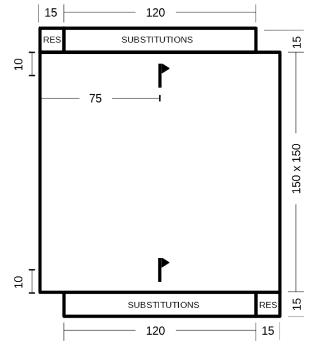
Field Layout: (See map following battle description)
- 150 ft square
- Flags will be supported by a tower of hay bales 10 ft from the center of the back line
- 15 ft square resurrection boxes on opposing corners
- Substitution boxes will be 15 ft x 120 ft outside of the field next to the resurrection boxes
General Rules:
- 60-minute limited resurrection battle
- 100 combatants from the kingdoms allied to the East vs. 100 combatants from the kingdoms allied to the Midrealm
- No principal kingdoms, allies only
- Combatants start along their back line
- Substitutions:
- Once you leave, you may not re-enter (Soccer substitutions)
- Those waiting to sub in must remain in the substitute box
- Combatants must move to the sidelines when they leave the field
- Scoring:
- A team scores a point when both flags are together at their tower
- Every time a point is scored, a hold will be called and the battle will be reset
- Flags and combatants return to starting positions
- Resurrection clocks are reset
Flag Rules:
- Flags must be held in an otherwise-empty gauntleted hand
- Flag bearers have 360-degree engagement
- If a flag bearer is killed, the flag must be immediately dropped
- Flags cannot be thrown or handed off to a teammate
- Only combatants on the opposing team may move a flag from its initial position
- Combatants may return their team’s flag to its initial position if it has been moved by the opposing team
Resurrection Rules:
- Dead combatants move to the resurrection box
- Resurrection boxes are simultaneously released every 3 minutes
- Resurrecting combatants who are not inside the box at release must wait until the next release
Victory Condition: “Touchdown” points
- Majority of points scored at the end of the battle determines the victor
- The battle will end when 60 minutes are up or when one team has seven more points than the other
Unbelted Champions – 11:00 AM or immediately following Allied Champions (1 Point)
- 35 champions from the East vs. 35 champions from the Midrealm
- 1 pass
- Last combatant standing
- Crowns may not fight, unbelted royal peers by their own hand may not fight, Unbelted Heirs may fight
- No Allies
Alternates/Allies Unbelted Melee – immediately following Unbelted Champions (0 Points)
- 25 combatants from the East & Allies vs. 25 combatants from the Midrealm & Allies
- 1 pass
- Last combatant standing
- Any combination of principal and allied combatants who were not in the Unbelted Champions battle
- No Chivalry
- Allied combatants may fight in both the Allied Champions Battle and the Unbelted Melee
Belted Champions – immediately following Unbelted Alternates battle (1 Point)
- 20 champions from the East vs. 20 champions from the Midrealm
- 1 pass
- Last combatant standing
- Crowns may not fight. Heirs may
- No Allies
BRIEF BREAK FOR FIELD COURTS
Rapier Melee Champions – 12:00 PM (3 Points)
- 15 champions from the East and Midrealm, 15 Allies per side (30 total fighters per side)
- Last combatant standing
- Battles will be fought in 3 heats:
- Heat 1: 15 v 15 East and Midrealm (1 pass)
- Heat 2: 15 v 15 Allied Kingdoms (1 pass)
- Heat 3: 30 v 30 – the champions who fought in Heats 1 and 2 (1 pass)
Alternates Rapier Melee – immediately following Rapier Melee Champions (0 Points)
- 15 combatants from the East & Allies vs. 15 combatants from the Midrealm & Allies
- 1 pass
- Last combatant standing
- Any combination of principal and allied combatants who were not in the Rapier Champions battles
Cut & Thrust Melee Exhibition (0 Points)
- 20 per side, non war point, will balance as necessary
- 3 passes
- No experimental weapons or weapons styles
- Limited to Side Sword only (38” or less)
Heroic Champions Armored and Rapier (Alternating) – 1:30 PM
List will be set up on the center of the southern half of the battlefield. List will be 100 ft x 100 ft
Armored Heroic Champions (1 Point)
- Armored: 15 total fights (3 will be unbelted)
- Principal Crowns may not fight. Non-principal Royal Cousins are able to fight
- Unbelted royal peers by their own hand and unbelted Crowns may fight as belted heroic champions
- First bout will be a non-scoring fight between Eastern heir Sovereign and Middle heir Sovereign to determine if East or Mid chooses first
- Double kills to be refought once only. If a second double kill results, the fight is a draw
- If due to draws an overall tie occurs in wins, a tie will be decided between the Heir Sovereigns of the East & the Midrealm
Rapier Heroic Champions (1 Point)
- 19 fighters from each side to participate in single combat
- At least 3 bouts are Cut and Thrust
- A minimum of 5 non–MOD fighters will be chosen to fight per side
- No sitting Crowns from Principal Kingdoms may fight
- Double kills to be refought once only. If a second double kill results, the fight is a draw
- Pairings will be arranged on Saturday, August 5th after the Meeting of the Crowns
- If due to draws an overall tie occurs in wins, a tie will be decided between tiebreaker champions of the East and Midrealm. Tiebreaker champions must be declared at or before the traditional Meeting of the Crowns following Opening Ceremonies. (This is the only case in which a fighter may be called on to fight more than once in the Rapier Champions tournament)
Armored Youth Exhibition (0 Points)
2 Division III fighters from East and Middle will compete in single combat for honor and glory (but not
points)
MONDAY, August 3, 2026 – Armored Bridge Battle – Rapier Stronghold Battle
– Arts & Sciences Champions
Arts & Sciences Champions – 9:30 AM (4 Points)
Schedule
7:30 – 8:00 am Staff Set-Up
8:00 – 9:00 am Entrant & Scorer Registration & Entrant Set-Up
9:00 – 9:30 am Scorers and Entrants Meeting
9:30-10:30 am Round 1
10:45-11:45 am Round 2
11:45-12:30 pm Lunch
- All individuals involved in any way with the Pennsic A&S War Point are highly encouraged to bring their lunch or make arrangements for lunch to be brought to them.
12:30-1:30 pm Round 3
1:45-2:45 pm Round 4
2:45 -3:30 pm Entrant Last Look
3:30 – 4:00 pm Announcements
4:00 – 5:00 pm Clean Up
Executive Summary
Pennsic 53 (2026) A&S War Point will be a panel-reviewed, rubric-based competition with artisans, entries,
and Scorers present. Each Entrant will have 4 Scorers, the lowest Scorer’s score will be dropped, and the
remaining scores are averaged.
War Points will be determined by cumulative score totals on each side, with points awarded for the total of
all entrants and the totals of each division (Laurel and non-Laurel) separately. A fourth War Point will be
awarded for the side which musters the most patronage from the populace.
The single highest average score in each category will be declared the victor in each respective category.
Arts and Sciences War Point – Detailed Rules
Glossary of Terms:
Principal Kingdom = East, Midrealm
Principal Sides = Kingdom of East plus its allies; Midrealm plus its allies
Entrant = populace member submitting an A&S entry to be evaluated according to the Pennsic rubrics for competition to the Pennsic A&S rubrics
Scorer = person assigned to review and score an entry based on Rubric criteria
Reviewer = person assigned to verify Scorer score sheets adhere to Rubric criteria
Division = The group in which an entrant competes, either the Laurel Division or the Non‑Laurel Division
Category types of entries:
- Made Objects (pre-1100 CE)
- Made Objects (1101-1350 CE)
- Made Objects (1351-1600 CE)
- Food & Beverage
- Performance
- Research Project & Paper
Each Side is encouraged to make every effort to submit at least one (1) Entrant for each Category/Division to encourage diversity in the arts represented. Neither side will be penalized towards the War Point calculations if not submitting an Entrant in any given category. Recognition of Category champion will be adjudicated based on entries received with recognition that lack of representation by one Side will not disenfranchise Entrants in that category from the opposing Side toward determination of Category Champion.
Entries must have been finished in the last two (2) years (completed no earlier than 8/1/2024) and cannot have been previously entered in a Pennsic Arts and Sciences War Point Championship.
Reproduction artifacts for entry must be documented in construction and design to a pre-1600 style. Research projects or theses must relate to a pre-1600 topic, or to a topic of direct import to a historical reenactor of pre-1600 lifeways. Food and beverage entries must be based on pre-1600 flavor profiles, ingredients, and processes. Performances should be of material demonstrated to be of a Pre-1600
composition style. Original compositions done in a period style are appropriate.
Divisions and number of entries:
Competition shall be divided into two divisions (Non-Laurel, Laurel). Participants are barred from multiple entries and may not switch divisions. An individual’s residency status for purposes of category eligibility shall be solely determined by their status as of May 1, 2026. Peerage status shall be determined by receipt of a writ, intention from the Crown, or induction into the Order of the Laurel as of July 1, 2026. Each side shall submit NO MORE than sixteen (16) entries combined to include Entrants from each Principal and Allies. Each side may include no more than four (4) members of the Order of the Laurel among their entrants.
Neither Principal side shall exceed a maximum of two (2) performance entries per side including allies, for scheduling reasons. Performance is defined as any entry which requests any specific action or recitation to be reviewed; allowable performance entries are for solo performance only (no ensemble performing arts entries). Incidental performance of skills related to entries during review shall not define the entry as performance.
All Entrants, regardless of category, must be physically present with their entry on the day of the A&S War Point competition and must participate in face-to-face dialogue with the Scorers.
As much as possible, timeslots will be assigned to attempt to reduce the number of hours of commitment needed for each Scorer and Entrant. Timeslot assignments will be assigned to accommodate communicated schedule constraints as much as possible while still maintaining a roughly equal distribution of Entrants and Scorers per time slot.
A&S Entrant and War Point Victors:
Each entry will be evaluated by four (4) scorers, two (2) from each principal side. Each scorer is expected to independently evaluate the entry based on the appropriate rubric and each score sheet will produce a numerical score. The lowest of these four (4) scores will be dropped and the entrant’s “adjudicated points” will be the average of the remaining three (3) score sheets.
A victor will be declared for each category, defined as possessing the most adjudicated points at the end of the review period. If there is only one Entrant in any category, they are the victor by default. Each Division will also have a Division Champion. Scrolls shall be provided for each declared Champion. Coordination of the scrolls is the responsibility of the “hosting” Principal but may be provided from any Kingdom.
There shall be four (4) A&S War Points. One (1) point will be awarded for each Division total, one (1) point shall be awarded for the combined Team total, and one (1) point will be awarded for “populace patronage”.
The Divisional War Point totals shall be determined by totaling all Entrant adjudicated points for a cumulative score by Division. In the event there are an uneven number of Entrants by Side within a Division, the number of Entrants counted from each side will be equal to the number of Entrants brought by the side with fewer Entrants. The Side which submitted a greater number of Entrants within the Division will be allowed to drop their lowest scoring entrant(s) within the Division until an equal number of War Point Entrants within the Division is reached.
The Combined War Point shall be determined by totaling all Entrants’ adjudicated points irrespective of Division. The Side which submitted a greater number of Entrants will be allowed to drop their lowest scoring entrant(s) until an equal number of War Point Entrants is reached.
In the case of a tie for the War Point, the scores will be re-adjudicated by adding the lowest Scorer’s score sheet back into each Entrants’ scores and the averages shall be recalculated. If all scores still result in a tie, the highest scoring entry from each side shall be compared by the A&S Generals of the Principal Kingdoms for the win.
The Populace Patronage point will be determined by asking attendees at the A&S War Point to declare the side they are supporting. There will be dedicated staff on the day of the War Point to tally the number of people declaring support for each side. Entrants, scorers, and other staff working for the administration and organization of the War Point activities will not qualify for the patronage tally. The War Point will be awarded to the side with the greatest number of populace members declaring for that side. In the case of an exact tie in the number of populace members, this point will not be awarded to either side.
Documentation:
A cover sheet is required for each entry (existing cover sheet format to be reviewed/edited and agreed upon by all Principals). Additional documentation is also required but may include written format and/or verbal defense, as well as video, graphic, pictorial, or other reasonable documentary formats. Entrants
have the right to supplement their documentation between submission by the agreed upon deadline and the start of Scorers’ meeting at the Pennsic A&S War Point competition, subject to other restrictions of this document. It is the sole responsibility of the Entrant to provide and prepare their own documentation, as well as any equipment (such as a tablet or laptop) which may be necessary to display relevant documentation.
The documentation submitted by an entrant is considered an intrinsic portion of the entry, and documentation produced by a third party is expressly prohibited; this includes written documentation produced by generative AI wholly or partially. Proofreading and editing assistance is acceptable prior to the date of final submission, but only suggestions may be offered as the Entrant must compile and
complete ALL documentation to be submitted themselves. Accommodation is allowed as required for individual Entrants on a case-by-case basis. Any use of AI in the process of preparing documentation or performing research should be disclosed by the entrant in the bibliography with the prompt, date and the AI program used.
AI use in A&S projects is discouraged, but if used, whenever AI assists with brainstorming, organizing, translating, or editing your own writing, you must clearly state how it was used, including the type of prompts or requests made. The creative and finished work itself must always be entirely your own, and AI may not generate any part of the final artistic or scholarly product. Participants remain fully responsible for the accuracy, integrity, and authenticity of all work they present.
All documentation, from all Entrants (primaries and allied) must be submitted in substantive form no later than July 1, 2026. Any errata documentation presented the day of the competition must be noted as such and should not significantly change the documentation but rather add supporting evidence or Entrant findings. This also includes any updates found while translating non-English sources as noted below.
Non-English language documentation is permitted but must be submitted in final form by July 1, 2026, with no grace period for rewrites or additions due to the need for an unbiased translation. This includes all documentation, even in part, to be reviewed that requires any level of translation into English from any language. Entrants are welcome to provide their own translations, if possible, but unbiased translators will still be required. Transcribers should be allowed as necessary to accommodate individual Entrants.
The goal of documentation is to describe the artisan’s process of creating their entry, show the evidence used in that process, explain the choices made based on that evidence, and demonstrate its connection to a pre-16th century culture. Many types of evidence can be used in documentation, including but not limited to:
- The work of modern historians and researchers
- Archaeological finds and analyses
- Museum pieces and other surviving objects or artwork
- Historical texts from the period in question
- Living/oral traditions.
Scorers should bear in mind that some types of evidence may not be available for a given time or place, and if there is any question about this, Entrants should be given the opportunity to discuss the availability of different types of evidence.
With this in mind, an additional note about living/oral traditions is warranted. Evidence from oral traditions or traditional practices is explicitly welcome in documentation. When used, evidence from oral traditions or traditional practices (just like other types of evidence) should be cited as to its origin and the evidence’s reliability and applicability to the project should be discussed. Artisans are encouraged to also review the SCA’s “Guidelines for the Recognition and Approval of Oral Tradition in the Arts and Sciences”
Selection of Scorers:
Primary Kingdoms will each provide a minimum of two (2) Scorers per entrant. Ideally no Scorer should be scheduled to review more than two (2) entries. Any ally that provides an Entrant must also provide a minimum of two (2) Scorers per entrant.
These Scorers shall be selected based on appropriate overall knowledge of the Arts and Sciences; their ability to read, understand, and justly apply the appropriate scoring rubric; and they shall possess adequate subject matter expertise in the area of the entry for which they have been primarily assigned, if at all possible, though this is not required.
A roster of Scorers shall be maintained by each General and shall be made freely available following the Scorers’ selection deadline of June 22, 2026 (six weeks prior to the competition). Alterations to this roster must be reported to all Generals within 72 hours of discovery.
Role of Scorers:
Scorers are to read the Entrants’ submitted documentation prior to Pennsic as well as discuss with the Entrant their entry and documentation during their assigned review session in order to provide a score based on the provided Rubric, free of undue influence or conflict of interest.
Scorers shall:
- To the best of their ability, apply the correct rubric as written to their assigned entry.
- Attend training (hosted jointly by the Principal Kingdoms) which will be offered online at least twice prior to Pennsic (and will also have recorded training available online) and from the beginning of
- Pennsic until the day before the competition as an optional session as requested for last minute Scorer substitutions.
- Work constructively with Entrants before determining the appropriate score.
- Allow time and space for Entrants to freely answer questions and provide additional information.
- Maintain a professional and compassionate demeanor when discussing the Entrant’s body of work, research, and documentation.
- Ask questions which allow the Entrant the opportunity to display any missing or faulty aspects of their entry or documentation.
- Give actionable, constructive written feedback to the Entrant on ways they can improve or elevate their work. THIS IS NOT OPTIONAL.
Replacing Scorers:
Scorers who withdraw prior to Pennsic should be replaced as soon as possible, and a replacement Scorer will be named by the corresponding General within 72 hours of discovery. The new Scorer shall be provided with all currently available materials, including available documentation.
Conflict of Interest between a Scorer and Entrant is unacceptable. Both Scorers and Entrants have a responsibility to discuss and to explain any potential conflicts, upon request, as well as to make the A&S War Point Staff or a General aware of any conflict.
Examples of Conflicts of Interest include but are not limited to; current and former formal SCA student/teacher relationships, current or former cohabitation, current intimate relationships, current or former business relations, as well as any other powerful social ties which gives any appearance of partiality.
By unanimous agreement of all Principal Generals, any Scorer may be removed or replaced at any time. Any replacement Scorers must be assigned from the existing pool of Scorers who have attended a training session. Any scorer who was removed from their job during a prior year’s Pennsic A&S War Point competition, or whose score sheet was discarded for not following the scoring criteria may only serve as a scorer for this year’s Pennsic A&S War Point competition by unanimous agreement of all Principal Generals.
Scorers Training:
Joint Scorers training will be provided at least twice prior to Pennsic (and made available online) with at least one (1) on-site training prior to War Week as an optional session for last minute Scorer substitutions.
Rubrics:
Rubrics for Made Objects, Performance, Food & Beverage, and Research will be agreed upon by the Principals no later than April 13 2026 (16 weeks prior to the competition) to allow adequate time for Entrants to update their documentation before the Documentation deadline.
Scorers training classes will be offered online by a joint effort of the Principal Kingdoms. All Scorers must attend at least one (1) class before reviewing the Entrants. Failure to attend at least one training session is an automatic removal from the reviewing pool. Each Kingdom is responsible for ensuring and confirming attendance by each identified Scorer. If someone does score a piece and has not attended the training and their resulting scoring is determined to be out of line compared to the other Scorers, regardless of score, that score should be the one dropped for consideration of placement.
Scorers may discuss the rubric scores and comments prior to submission but must score individually. There can be no substantial duplication of commentary between the Scorers. If the commentary is found to be overly critical without constructive feedback, it will not be given to the Entrant and may be excluded from the score at the mutual discretion of the Principal Generals.
Scoring:
Each Scorer shall submit their scores to the Generals’ Staff table for calculation as soon as possible after their review session. Official calculations shall be performed by the Generals’ Staff. An unweighted average of scores, after striking the lowest score, will be utilized to calculate the Entrant’s final score. All scoring assumes starting from a perfect starting score. Any reductions of score in any scoring area must include rationale for the reduction and constructive feedback on how a higher score might have been achieved.
Reviewers:
Each Principal Kingdom shall provide a minimum of 2 Reviewers to review score sheets. Each Entrant will have no fewer than two (2) Reviewers (one (1) from each Principal side) review all four (4) score sheets submitted for that Entrant. The purpose of the Reviewers is to ensure scoring and commentary adequately meets the requirements bulleted in the section “Role of Scorers” noted above in this document. Restated from the final sentence in the “Rubrics” section above, “If the commentary is found to be overly critical without constructive feedback, it will not be given to the Entrant and may be excluded from the score at the mutual discretion of the Principal Generals.”
Set-up expectations:
The designated Hosting Kingdom shall be accountable for reserving the space, setting up tables and chairs for each Entrant, coordinating water and snacks for the competition, and verifying that the space is clear and clean at the end of the competition. All other Kingdoms participating in the A&S War Point Competition are expected to provide assistance in setup and take down.
Armored Bridge Battle – Monday 10:00 AM (5 Points)
Field Layout:
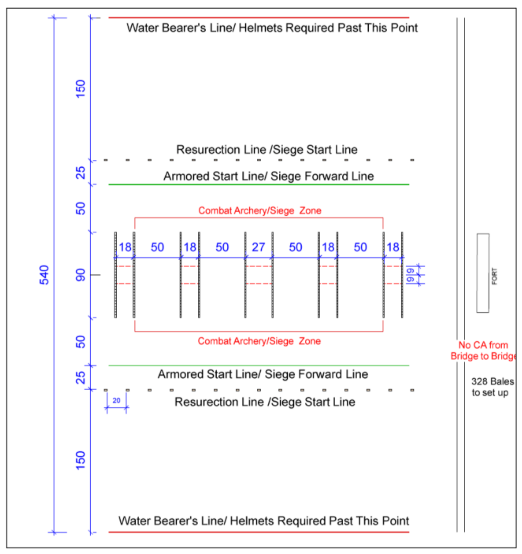
- 5 Bridges 18 ft, 18 ft, 27 ft, 18 ft, 18 ft, separated by 50 ft each. Each bridge is 90 ft in length
- Start line for troops and forward siege line is 50 ft from the end of the bridge. Traditional starting sides
- Resurrection line and siege start line is 75 ft from the end of the bridge
- Edge-of-the-World will be 150 ft behind the siege lines
- Bridges will run east-west
General Rules:
- Battle to be fought 5 times
- Each battle will last 15 min with a 10 min break between
- No fighting or kneeling on the hay bales. Incidental contact is ok, but you cannot bear weight on the hay bales
- Breakouts are allowed until the 15 min time limit has expired, when teams will fight to determine contested bridges
- Holds:
- All holds, except medical, are assumed to be local and do not stop the clock
- MEDICAL HOLDS MUST BE CLEARLY ANNOUNCED BY MARSHALS. Medical holds stop the clock
Projectile Weapons:
- Combat Archery and Siege:
- Active in battles 1/2/3
- Allowed to target combatants on bridges 2/3/4
- May be stationed between inner edges of bridges 1 and 5
- No arrows or siege ammunition will be re-inspected between battles
- Combat Archery:
- Archers can go on bridges
- Archers may not shoot from bridge to bridge
- Archers may shoot from land to bridge
- Only Combat Archery tubular arrows/bolts may be gleaned
- Siege Engines:
- Engines can only deploy no closer than 50 ft from the end of the bridge
- Siege ammunition may not be gleaned
- Siege cannot fire into a local hold.
- Thrown weapons will be allowed on all bridges in all battles
Resurrection Rules:
- Resurrection will be active for the first 10 minutes of each battle, and will be closed for the last 5 minutes. Combatants do not need to be on a bridge when resurrection closes to remain active in the battle
- Raised Banners on the resurrection line will indicate that Resurrection is active. Banners will be dropped at 10 minutes to indicate resurrections have ended for the remainder of the battle
Victory Condition: Bridge Control
- Control of the center line at the end of the 15 minutes will determine the bridge winner
- Control of the center line is defined as control of 9 ft past the center line of the bridge with at least one combatant remaining on the bridge
- If the bridge is contested when time has ended, combatants with one foot physically within 9 ft of the center line will fight to the last combatant standing. Breakouts from contested bridges are not allowed
- Victory for each pass is decided by ownership of 3 of the 5 bridges at the end of time or last combatant
- In the event of a tie, no points will be awarded
Rapier Stronghold Battle – Monday 1:00 PM (5 Points)
Field Layout:
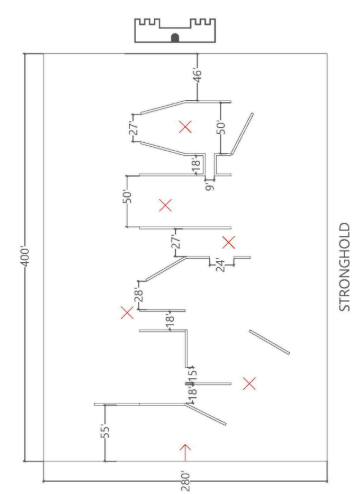
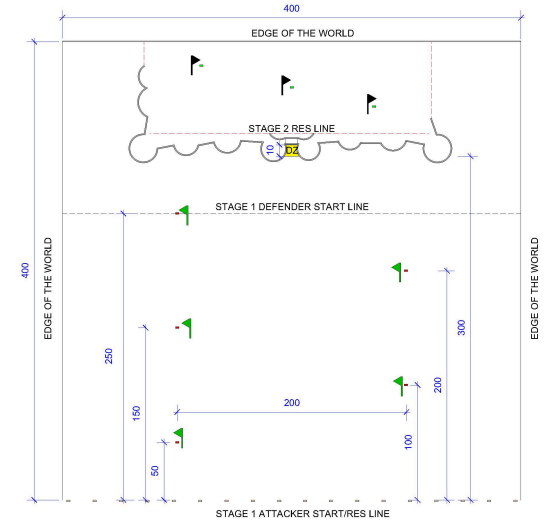
- 400 x 280 ft
- 5 colored flip-sticks (banners), positioned unevenly on the field from the South to the North
- Distance between banners decreases progressively
- There will be obstacles on the field around or between the banners
General Rules:
- Attack/Defend battle, fought twice
- Whichever side is down on points after Sunday gets to decide who attacks first
- Progressive banner capture (see below)
- Banners:
- Must be captured in order from South to North
- Cannot be recaptured by the Defenders
- Captured banners become resurrection points for the Attackers only
- Cannot be obscured by any object (e.g. a shield)
- Will be reset between battles
- Deployment:
- Attackers must start at the southernmost border of the field
- Defenders may start anywhere behind the southernmost banner
- Holds:
- All holds stop the clock
- 10 minutes to reset scenario in between runs
Special Weapon Rules:
- Rapier Spears are allowed
- Projectile weapons (e.g. rubber band guns) are allowed in this battle
- No gleaning of shot on the field
- Only shields are proof against shot
Resurrection Rules:
- Unlimited resurrection for 30 minutes. At the end of 30 minutes, if the attackers have not captured the northernmost banner:
- Defenders will no longer be allowed to resurrect
- Attackers will still be allowed unlimited resurrection
- Attackers can resurrect at the starting line OR any captured banner
- Defenders may only resurrect at their designated resurrection zone at the top of the field
Victory Condition: Attack time
The side that captures the northernmost banner in the least amount of time wins the scenario
TUESDAY, August 4, 2026 – Archery Champions – Woods Battles
Archery Champions – 9:00 AM (4 Points)
- 8:00am muster, 9:00am start
- Lunch around 1:00pm
- Anticipate finish around 3:00pm
- No populace shooting on this day
- 40-person teams
- 24 from principal kingdoms
- 16 from allies
- Three separate shoots
- 10 station Roving Range Shoot
- Four Teams: Mid vs. East / Mid Allies vs. East Allies
- Winner of this shoot between Mid and East receives 1 war point
- Winner of this shoot between Mid Allies and East Allies receives 1 war point
- Friend / Foe Shoot
- Two Teams: Mid and Mid Allies vs. East and East Allies
- Winner of this shoot receives 1 war point
- Clout Shoot
- Two Teams: Mid and Mid Allies vs. East and East Allies
- Winner of this shoot receives 1 war point
- 10 station Roving Range Shoot
For Both Armored & Rapier Woods Battles:
Field Layout:
- Banner positions and resurrection lines
- Will be decided at Pennsic by Marshal One, Rapier One, and respective East and Midrealm generals during a walk-through of the woods, a day or more before the battles
- Will be the same for both the Armored and the Rapier Woods Battles
- Stationary Banners:
- 3 colored flip-sticks (banners) and hay bales will denote the location of the banner and the color pointed upwards will indicate possession of the banner
- The Center Banner will be located at the exact center of the rectangle of the woods battle area
- The North and South Banner will be set equidistant approximately 200 ft from the Center Banner
- All three banners will be positioned equidistant from the respective start lines
- Mobile Banners:
- 2 colored flip-sticks will be used as mobile banners
- Holding the mobile banner will indicate possession
- A haybale located at midpoint between the center banner and north/south banners will define the starting location of the mobile banners
- Mobile banners may be moved within the designated zone
- North mobile banner must stay between center and north banner (30 ft from center and north banner)
- South mobile banner must stay between center and south banner (30 ft from center and south banner)
- From 30 ft west of banner centerline to 30 ft east of banner centerline
- Mobile banner range is approximately 60 ft east-west by 120 ft north-south
- Resurrection Lines
- Will be clearly designated by the marshals as determined during the walk-through of the woods
- Will be set equal in distance from the Center Banner Line for each side
General Rules:
- The side that is down in points by 4 pm (16:00) of the prior day will choose which side they want to start on
- One marshal from the East/Allies and Midrealm/Allies MUST be present at each banner
- Time Checks:
- Exact time checks will be determined by Signal prior to the battle
- Exact time checks will not be disclosed to marshals prior to the start of the battle and will not be announced or counted down over radios
- Exact time checks may not be disclosed to combatants any time
- Mobile banners will be reset to their starting positions at each time check
- Holds:
- All holds, except medical, are assumed to be local and do not stop the clock
- MEDICAL HOLDS MUST BE CLEARLY ANNOUNCED BY MARSHALS. Medical holds stop the clock
Victory Condition: Banner Control:
- Majority control of banners at time checks determines the victor of that time check
- Contested banners are not counted. Ties are possible
- A contested banner is defined as:
- A mobile banner not in the designated zone or not being held by a combatant
- A stationary banner that is not upright in a haybale
Armored Woods Battle – Tuesday 10:30 AM (4 Points)
General Rules:
- 90-minute resurrection battle
- All banners must be held in a gauntleted hand
- There will be 3 time checks within ± 2 minutes of 30, 60, and 90 minutes of battle
- 1 Point awarded per each of three time checks.
- In the event of a tie during a time check, no point will be awarded at that time. Instead, the point will be determined by the overall banner count at the conclusion of all time checks.
- 1 (or more, in the case of a tie) Point(s) will be awarded to the team with the greater total number of banners earned across all time checks.
Projectile Weapon Rules:
- Combat Archery:
- CA will be allowed within the designated zone by the North Banner
- Both archers and targets must have both feet in the zone to be considered in the Archery zone
- Only shots within the designated zone will be considered valid
- The edges of the zone will be clearly marked
- Only tubular arrows/bolts may be gleaned
- There will be no siege in this battle
- Thrown weapons are allowed throughout the woods. (See Armored Combat Conventions at the beginning of this document)
Rapier Woods Battle – 1:30 PM (4 Points)
General Rules:
- 60-minute resurrection battle
- All banners must be held in an open or free hand
- There will be 4 time checks within ± 2 minutes of 15, 30, 45, and 60 minutes of battle
Special Weapon Rules:
- No projectile weapons (e.g. rubber band guns) are allowed in this battle
- Rapier Spears:
- Rapier spears will be allowed within the designated zone by the North Banner
- Only shots within the designated zone will be considered valid
- The edges of the zone will be clearly marked
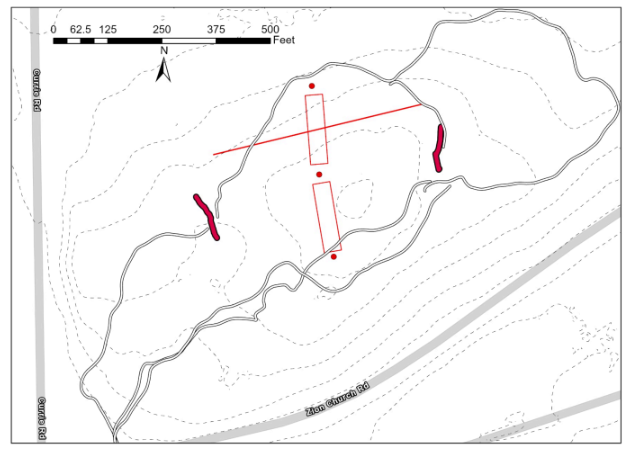
Alternate Tuesday battles – if the Woods are not safe or otherwise unavailable
Armored Alternate Battle – 10:30 AM (4 Points)
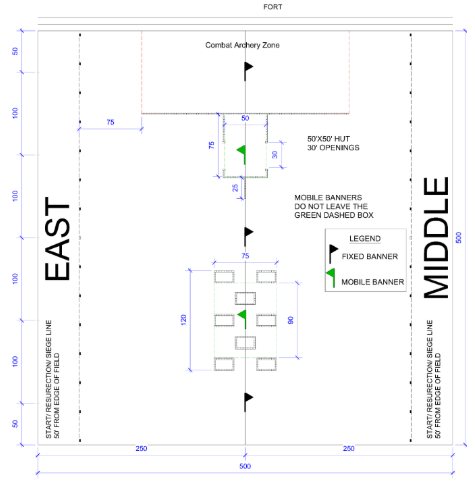
Field Layout (See map following battle description):
- Same rules as woods battle: 3 stationary banners and 2 mobile banners that must remain within designated zones
- Hay bales in the Broken Field area will be 2 bales high
- Armies will deploy from the resurrection line
General Rules:
- Scenario is the same as the woods battle
- Midrealm and East to deploy on their traditional half of the battlefield
Projectile Weapon Rules:
- Combat Archery is allowed in a zone starting 30 ft north of the center banner and extending to the north edge of the world
- Combat Archery cannot fire over hay bale walls
- There will be no siege in this battle
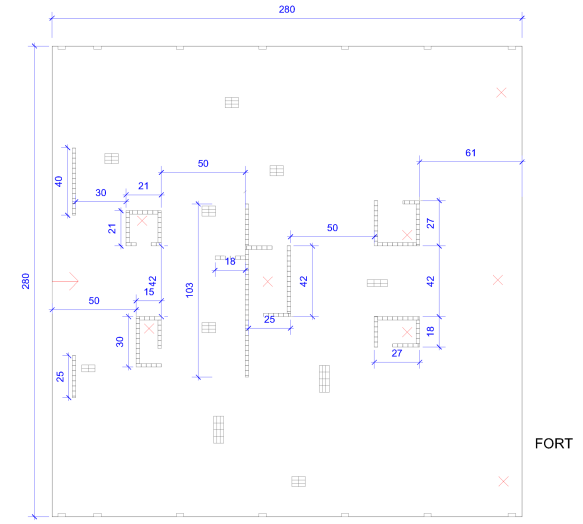
Rapier Alternate Battle: McGuffin Battle – 1:30 PM (4 Points)
Field Layout: (See map following battle description)
- Five buildings as laid out on the map:
- MacGuffin placement is indicated by an “x” on the map
- All doors are 9 ft wide
- Building 1: 15 ft long by 30 ft wide
- Building 2: 21 ft long by 21 ft wide
- Building 3: 27 ft long by 42 ft wide
- Walls extend from the edges of the building closest to the northernmost border of the field
- 36 ft past the building edge toward the West
- 15 ft past the building edge toward the East
- 18 ft perpendicular to the building 6 ft back from the building edge extending north toward the attacker’s resurrection line
- Building 4: 18 ft long by 27 ft wide
- Building 5: 27 ft long by 27 ft wide
- Piles of hay bales “randomly” placed on the field
General Rules:
- 30 minute (maximum) Attack/Defend battle, fought twice
- Scenario will end after 30 minutes OR when all 5 MacGuffins are “scored”
- Scoring is accomplished by carrying the MacGuffin completely across the attacking res line
- Order will be determined by a coin toss
- Heads – East attacks first
- Tails – Midrealm attacks first
- All hay bale walls are “infinitely tall”. They cannot be passed through or fought over. Dead may exit out over single height hay bales
- MacGuffin rules:
- Require exactly 4 people to carry
- The MacGuffin will be dropped in place if any carrier(s):
- Require exactly 4 people to carry
- Are killed
- Lose the arm holding the MacGuffin
- Lose a leg (Knee walking with MacGuffin is not allowed)
- Must be held in an open or free hand
- Swords, daggers, bucklers, etc. cannot be held in the hand holding the MacGuffin
- Weapons or parrying devices in the other hand may be used to fight or parry
- Any items held in the off-hand may be securely sheathed or handed to someone with an open hand
- At no point during battle can a person hold two items in a single hand
- Swords, daggers, bucklers, etc. cannot be held in the hand holding the MacGuffin
- Defenders may not move the MacGuffins
- Spears cannot attack any person carrying a MacGuffin
- MacGuffins will be reset between battles
- MacGuffins must be carried completely across the Attacker’s resurrection line to “score”
- Must be held in an open or free hand
- Deployment:
- Attackers start at the northern border of the field
- Defenders may start anywhere behind the northernmost banner
- Holds:
- All holds stop the clock
Special Weapon Rules:
- Rapier Spears are allowed
- Projectile weapons (e.g. rubber band guns) are allowed in this battle
- No gleaning of shot on the field
- Only Shields are proof against shot
Resurrection Rules:
- Unlimited resurrection
- Attackers resurrect at the starting line
- Defenders may resurrect at any of three resurrection points at the south end of the field
Victory Condition: McGuffin Completion OR McGuffin Completion Time
- The side that “scores” the most MacGuffins in 30 minutes wins the scenario and is awarded all of the points
- In the event of a tie, the side that scored the last MacGuffin in the least amount of time wins the scenario
THURSDAY, August 6, 2026 – Thrown Weapons Champions – Combined Scenario-Castle Siege – Combat Archery & Siege Battle
Thrown Weapons Champions – 8:30 AM (2 Points)
Targets/Range Setup:
- Use standard round targets (no board targets in this format)
- Hard Targets (Rounds)
- Concentric Circles (pair): three painted concentric scoring zones (for axe and knife). Standard Universal Royal Round Target sizing
- Three Bars (pair): three horizontal bars; each bar contains a contrasting 1–2 inch square scoring zone (for axe and knife). The bars should be 2 inches high – and somewhere between 8-10 inches long, scoring zone is 2×2 inches. See example images below:
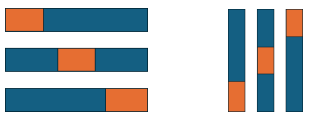
- Soft Targets (Hay Bales)
- Hay-bale stack (pair): 4 hay bales tall, with a target of a 12 inch square scoring zone (for spear/javelin)
- Scoring zone on the hales bales should be at the same height/placement between the pair of targets
- Scoring zone may be painted on the hay bales directly or be made of cardboard or some similar allowable soft weapon target material
- Optional 2 Ground Targets for Plumbata (if space/materials allow)
- 1 target in concentric rings
- Suggested Sizing: 1 ft center diameter, 3 ft middle ring, 5 ft outer ring
- 1 target in the 3 bars style to match the axe/knife style
- With appropriate size to scale for the plumbata
- Suggested Sizing: 1 ft high by 4 ft wide with scoring zone 1 ft high by 1 ft high
- 1 target in concentric rings
Team Composition:
- 14 adult champions per team (includes Kingdom Champions and/or Team Captain)
- 1 Youth Champion head-to-head (separate match)
- Select 2 alternates per side that will be ready on competition day in the case someone on the team is unable to compete these folks can step in
Order of Competition/Pairings:
- Kingdom Champions/Team Captains compete first (match 1)
- Head-to-head pairings, post Meeting of the Crowns
- Winner of the first match will select the next thrower from their side to compete, the other side will select an opponent to meet the competitor (match 2)
- Match 3 will then be selected by the losing side from Match 1 – the other side will select an opponent to meet the competitor
- Match 4 will be selected by the winning side from Match 1 …. Etc and the selection process will continue in this manner
- Do recommend having the youth go near the top or middle of the competition
- Do make sure the alternates get a chance to throw at the end – they worked for it and deserve to throw
General Rules:
- Minimum Distances
- Axe/Knife: minimum 10 ft
- Spear/Javelin: minimum 20 ft
- Plumbata: minimum 25 ft
- Each competitor in a match shall throw the same number of weapons (same number of scoring throws)
- All competitors must follow posted range safety and retrieval rules
Match Format:
- Adult matches: 14 total head-to-heads.
- Youth match: 1 head-to-head.
- For each head-to-head:
- Hard Target #1 (axe/knife): 2 heats, 5 throws per heat (10 throws total)
- Hard Target #2 (axe/knife): 2 heats, 5 throws per heat (10 throws total)
- Soft Target (spear/javelin): 1 heat, 3 throws (3 throws total) – from 20 ft
- Soft Target (spear/javelin): 1 heat, 3 throws (3 throws total) – from 25 ft
- Pennsic 53 Ground Target 1 (Plumbata): 1 heat, 3 throws, (3 throws total)
- Pennsic 53 Ground Target 2 (Plumbata): 1 heat, 3 throws, (3 throws total)
- Total scoring throws per competitor: 32
- Heat procedure (hard targets)
- Competitors select which weapons to throw in Heat 1; the remaining weapons are thrown in Heat 2
- Where a paired target set is used, competitors swap to the adjacent paired face for the second heat to equalize wear/conditions.
- Heat procedure (soft targets)
- Competitors will throw the first heat from 20 ft, competitors will throw the second head from 25ft
Scoring:
- Scoring values must be posted and identical for both sides, based on the defined target faces above (concentric circles and bar/square target; soft target square zone)
- Scorekeepers should record per-heat totals and match total for auditability
- Score and Retrieve is allowed on any target at any time – to be called by the Competitors
- Spear/Javelin – if the handle of the weapon is touching the ground, must show clear indication of being in the target (Scorekeeper/Range Marshal must agree)
- Concentric Circles Hard Target
- Standard URR scoring 5,3,1
- Line break in favor of the thrower
- Horizontal Bars Hard Target
- If the target is spaced in such a way that the thrower can hit 2 scoring zones they must pick one after the throw
- Competitor can only score once on each line
- Each hit in the scoring zone counts as 3 points, each hit of the bar is 1
- Line break in favor of the thrower
- Soft Target Hay bales
- Each hit in the scoring zone counts for 5pts
- Line break in favor of the thrower
- Optional Weapon Plumbata
- Concentric Circles – Center 5, Mid 3, Outer 1, line break in favor of thrower
- Bars – In the scoring zone is 3, hit of the bar is 1 – you CAN repeat lines – line break in favor of the thrower
- Max Score
- Axe/knife concentric circles: max 25 a heat, 2 heats – 50 points total
- Axe/knife bars: max 15 a heat, 2 heats – 30 points total
- Plumbata concentric circles: 1 heat 3 throws max 15 points total
- Plumbata bars: 1 heat 3 throws max 9 points total
- Spear 20ft: 1 heat 3 throws max 15 points total
- Spear 25ft: 1 heat 3 throws max 15 points total
- Tie Break
- If the match is tied after all scheduled heats:
- Conduct sudden-death single-weapon throws, starting at the leftmost target in the set and moving to the next target as needed, until the tie is broken.
Victory Condition:
- The team that wins the majority of the head-to-head matches wins the war points
Combined Scenario – Castle Siege – 10:00 AM (7 Points)
General Rules:
- 1 battle, fought twice as attack/defend for time
- Faster combined armored/rapier attack time wins
- Attackers have unlimited resurrection. Defenders have 1 resurrection. This is true for both armored and rapier iterations.
- The side that is down in points by 4 pm (16:00) on Tuesday will have the option to attack or defend first. If tied, the winner of a coin flip will choose.
- Battle is fought in 2 stages, armored and rapier
- Combatants may participate in both armored and rapier halves of the battle, provided they re-armor appropriately
Stage 1 – Armored – Castle Breach:
- Victory condition will be transport of a heavy, handled box of “explosives” to a marked “detonation zone” (DZ). The DZ will be established by the marshals adjacent/front to the castle gate. The DZ will be the width of the gate, 10 ft deep.
- East will provide the box.
- Box starts behind the initial resurrection line, 300 ft from the DZ
- Anyone carrying the box must do so with a gauntleted hand. Four combatants are required to carry the box at all times. If the box has less than four live combatants carrying the box, the box must remain stationary until four live combatants carry the box.
- Box “explodes” to stop time as soon as any part of the box enters the DZ
- Between the initial resurrection line and the DZ are 5 left/right staggered points every 50 ft marked by a hay bale with a colored flip stick. These can be “flipped” to become additional res points
- Defenders resurrection points will be at the corner towers
- Combat archery and siege equipment allowed throughout armored portion. No gleaning of arrows or siege ammunition allowed
- Once the armored team stops the clock, there will be a 15-minute change out to rapier
Stage 2 – Rapier – Castle Assault:
- The victory condition is flipping 3 banners within the castle
- Banner/Flip Stick 1 is 50 ft inside the main door. Banner/Flip Stick 2 & 3 are 50 ft inside each side entry point
- Banner/Flip Stick locations will be designated by hay bales
- Once flipped to the attacker’s color, they cannot be flipped back to the defender’s color
- The clock stops when the 3rd banner is flipped to the attacker’s color
- Combatants may only enter the castle through the main gate or side entries
- Back edge of the castle is the edge of the world
- Attacker resurrection line will be the southernmost edge of the DZ
- Defender resurrection line will be the edge of the world
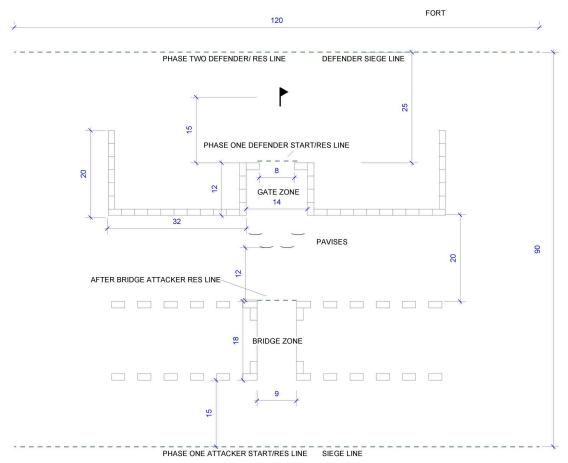
Combat Archery & Siege Battle – 3:00 PM (1 Point)
This scenario is designed as a proving ground for combat archers and siege crews. It places ranged combat at the center of success while still giving rattan fighters a meaningful role that does not rely on hand-to-hand dominance.
General Rules
There are two timed phases: Attacker Phase and Defender Phase. Both sides run the same scenario. A coin toss will determine which side attacks first. The side with the fastest successful capture of the flag wins. Attackers have unlimited resurrections. Defenders have 2 resurrections (3 total lives).
For purposes of this scenario, “direct fire against fighters” means any siege shot intentionally aimed at, led onto, or adjusted onto an individual fighter or a discrete group of fighters.
Weapons and Roles
- Primary Combatants:
- Combat archers: no more than 25 per side
- Siege engines and their crews
- Restricted Combatants:
- Rattan fighters may use only thrown weapons and shields.
- No more than 15 rattan fighters are allowed per side.
- Rattan fighters may:
- Carry the battering ram, if in full gauntlets
- Build the bridge
- Retrieve the banner once objectives are met
- No rattan striking. No shield rushing
Attacker Phase Overview
- Objective 1: Build the Bridge
- A marked Bridge Zone represents a moat or gap
- The bridge is considered built when five living attackers are simultaneously inside the Bridge Zone for two consecutive minutes. If the number of living attackers in the zone drops below five, the timer is paused until the number returns to five
- After two consecutive minutes are completed, the marshal calls “Bridge built.” The bridge is then considered complete and passable
- Objective 2: Knock Down the Gate
- To bring down the gate, the attackers must complete one of the following:
- Knock down all four pavises with siege fire
- Hold the Gate Zone for five consecutive minutes with the battering ram
- The gate timer may not begin until all four pavises have been knocked down by siege fire or five minutes have passed
- The battering ram is heavy and may move only at a walking pace. It must be carried by at least four living carriers. Carriers must wear full gauntlets on the carrying hand and may carry a shield in the other hand
- To count time toward the Gate Zone objective, the ram must be in the Gate Zone with:
- at least four living carriers
- at least two living combat archers inside the Gate Zone
- If either number drops below the required minimum, the timer is paused until both requirements are restored
- When the attackers complete two consecutive minutes under those conditions, the marshal calls “Gate down.” The door is removed immediately
- To bring down the gate, the attackers must complete one of the following:
- Objective 3: Capture the Flag
- The inner flag may only be taken after the gate falls
- Area control is expected to be achieved primarily by archery and maneuver. Siege supports the assault by engaging designated scenario objectives and marshal-approved area-denial zones
- Siege engines may engage only designated structural or scenario objectives, including pavises, gates, walls, and other targets specifically identified by the marshals. Siege may not be used for direct fire against individual combat archers or other individual fighters
- Once the flag is removed or seized, the phase ends and the time is recorded
Defender Phase Overview
- Sides switch roles. The defender phase uses the same field, same objectives, same restrictions, and same marshal calls
- Combat archery and rattan defenders may begin anywhere behind the Bridge Zone. Defending siege must begin behind the fort and will operate with limited targeting opportunities based on the field layout
- The defending side’s goals are to:
- Kill or suppress archers
- Break ram teams
- Prevent bridge completion
- Delay flag capture as long as possible
Overall Victory Condition: The side that captures the flag in the shortest time across both phases is the winner.
FRIDAY, August 7, 2026 – Field Battles
Both Armored & Rapier Field Battles:
General Rules:
- Battle to be fought 5 times
- 1 Life per Combatant. No Resurrection
- Midrealm and East to deploy on their traditional half of the battlefield for every battle
- All holds are general
- There will be 10 minutes between the end of each battle and the start of the next
Victory Condition: Last Combatant Standing
Armored Field Battle – 10:00 AM (5 Points)
Field Layout:
- 500 ft x 500 ft
Projectile Weapon Rules:
- Combat Archery and Siege:
- Active in battles 1/2/3
- Siege starts at 50 ft from edge of field
- Only Combat Archery tubular arrows/bolts may be gleaned
- No siege ammunition may be gleaned
- No inspection of ammunition between field battles
Rapier Field Battles – 1:00 PM (5 Points)
Field Layout:
- 400 ft x 400 ft
- May be subject to change based on the number of combatants at the agreement of the Crowns of the East & Midrealm
- “Edge of the world” lines will be marked by battlefield coordinator
Special Weapon Rules:
- No projectile weapons (e.g. rubber band guns) are allowed
- Rapier Spears:
- Active in battles 3/4/5
Populace Competitions
Populace Thrown Weapons (1 Point)
Targets/Range Setup:
- One Hard target each for: Axe, Knife
- One Soft Hay Bale target for Spear
General Rules:
- Any member of the populace may participate, subject to standard range authorization and safety rules
- Points earned by throwers will be tallied daily and posted in the marshal tent.
- Range closing: barring environmental/safety closure, the populace range shall close no earlier than 15 minutes before posted range closing time.
Competition:
- A single pass consists of throwing at all three stations: Axe, Knife, and Spear
- At each station, the thrower may make up to 3 scoring throws with that weapon form
- Maximum per pass: 9 scoring throws (3 per station × 3 stations)
- Each individual may have points tallied for up to 5 total passes
- Passes may be completed all at once or across multiple days
Scoring:
- Axe/Knife targets:
- 5 points = center
- 3 points = middle ring
- 1 point = any other stick on the target face
- Score and Retrieve at any time
- Line Cross in favor of the thrower
- Spear target (hay bales):
- 5 points = top hay bale
- 3 points = middle bale (or second from top if 4 high)
- 1 point = stick anywhere else on the stack/target face
- Score and Retrieve at any time
- Line Cross in favor of the thrower
Victory Condition: Highest overall points scored (as defined by the war point bookkeeping method in the Pennsic ruleset—e.g., cumulative by side if the war point is side-scored)
Populace Archery Shoot (1 Point)
Targets/Range Setup:
- Castle Clout Shoot
- The target is a simulated castle turret.
- 27 ft x 27 ft square set 100 yards from the line.
- There will be a moat monster protecting the castle in front at about 50 yards.
- Advancing Soldier Shoot
- Targets set at 15 yards, 35 yards, 45 yards, and 55 yards
- Castle Window Shoot
- Target is an object inside the castle window
- Castle window will be set between 25 and 35 yards
- The Castle Window will be at least 8 inches wide by 36 inches tall
General Rules:
- 3 separate competition shoots
- All shoots are untimed
- Archers are allowed to shoot 6 arrows or bolts for each shoot
- Total number of points earned by archers will be tallied daily for each shoot
- Scores will be tallied each day and posted in the Marshals Tent
- Any member of the populace may participate
- Individuals may have their points tallied for 5 total passes at each shoot which can be done all at once or over multiple days
- Multiple individuals may share a bow; however, it must be inspected with each user to ensure safety
Competition:
- Castle Clout Shoot
- Archers will shoot at about 100 yards into the castle turret
- Scoring:
- 1 point for inside the moat
- 2 points for hitting the moat monster
- 3 points for inside the castle
- 4 points for hitting objects inside the castle
- Advancing Soldier Shoot
- Any arrow or bolt hitting the painted portion of the target scores as follows:
- 1 point for the 15-yard target
- 2 points for the 35-yard target
- 3 points for the 45-yard target
- 4 points for the 55-yard target
- Any arrow or bolt hitting the painted portion of the target scores as follows:
- Castle Window Shoot
- Scoring:
- 1 point for each arrow or bolt inside the castle window
- 2 points for each arrow or bolt inside the object in the castle window
- Scoring:
Victory Condition: Overall points scored for each Shoot
Service Challenge (1 Point)
Service Challenge (1 Point)
- Sunday through Thursday of War Week
- Will be reported by the volunteers in charge of the volunteer points at the end of each day via a google form via a QR-Code (East alignment Blue, Midrealm alignment Red)
- Service Categories/places to log hours that count towards the challenge. QR-Codes will be posted at each of the service organization locations and non-electronic reporting formats will be available at the East & Midrealm Kingdom encampments main gates.
- Marshal Point
- Watch
- Herald Point
- Family Services
- Archery Range
- Thrown Range
- Information Point
- Troll
- Lost & Found
- Accessibility Services
- Teaching classes (Pennsic University registered)